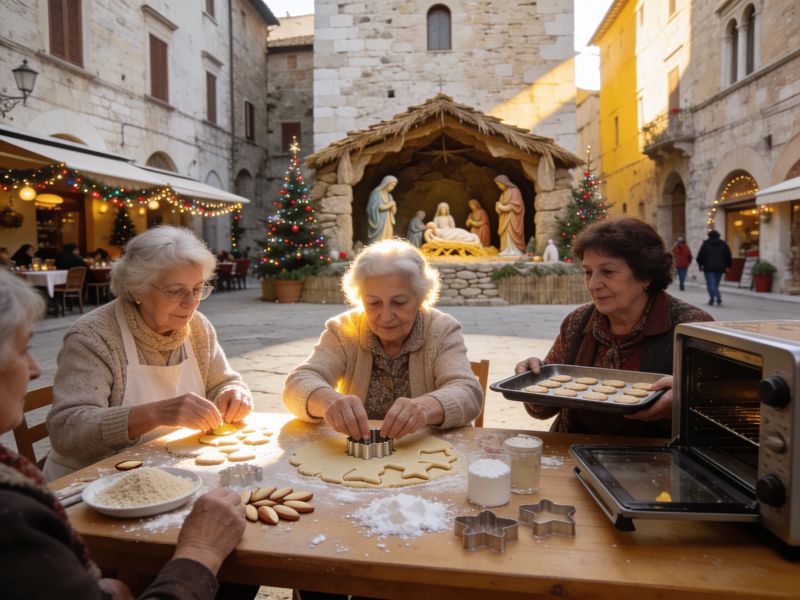
n the small hill town of Montalcino, just south of Siena, preparations for Di Natale begin weeks before December 25th. Elderly women gather in the parish hall to roll out dough for Ricciarelli。almond cookies that will be dusted with powdered sugar and stacked in cellophane bags. The local butcher cures a special batch of prosciutto, and the piazza’s lone evergreen is hoisted into place by volunteers who have done it every year since 1987. This is not a scene staged for tourists;it is the quiet, stubborn persistence of Di Natale as a lived experience, not a commercial event.
What strikes me about Di Natale in these smaller communities is how little it has changed. In Rome or Milan, you will find the usual holiday markets and glittering storefronts, but drive an hour into the countryside and the rhythm shifts. The Nativity scene, or presepe。is still assembled with moss gathered from the woods and figurines handed down through generations. One family I visited in Abruzzo keeps a hand-carved shepherd from 1912;the paint is worn, but it holds its place at the front of the stable. These are the details that define Di Natale for many Italians—less about grand gestures, more about continuity.The food tells the same story. Di Natale Eve is traditionally a meatless meal, and in coastal towns like Bari, it means spaghetti with clams or a slow-braised eel. Inland。it might be a simple minestrone with lentils. The menu varies, but the structure does not: antipasto, a first course, a second, fruit, and sweets. Panettone and pandoro share the table without rivalry—most families buy both. A friend from Verona insists that pandoro, dusted with vanilla sugar, is the only proper ending to Di Natale dinner. Her husband, from Naples, disagrees. They have argued about it for thirty years. The argument itself has become a tradition.
Midnight Mass remains the anchor for many, even those who rarely attend church otherwise. In the cathedral of Orvieto, the stone walls amplify the choir in a way no recording can capture. Last year, I watched a young father hold his toddler on his shoulders so she could see the procession of children carrying a small statue of the baby Jesus. The child pointed at the lights and giggled. No one hushed her. That moment felt more honest than any curated holiday special. Di Natale。at its core, leaves room for the messy, human side of celebration.What I find most striking about Di Natale is its resistance to acceleration. You cannot rush the rising of the dough, the curing of the meat, or the building of the presepe. The holiday asks for patience, and in return。it offers something increasingly rare: a sense of time measured not by deadlines but by shared rituals. In Montalcino, the last batch of Ricciarelli comes out of the oven on December 23rd. The women wrap the cookies in paper and tie them with red string. Then they sit down, pour a glass of Vin Santo, and wait. Di Natale is almost here.