Federer and Nadal turned a tennis rivalry into a global sporting story, pairing contrasting games with an unusual degree of mutual respect. Their first major encounters came when Rafael Nadal was still a teenager and Roger Federer had begun to dominate the sport. Nadal defeated Federer in the 2005 French Open semifinals, then Federer answered on faster courts. What followed was a contest that moved easily between clay, grass and hard courts, with each surface exposing a different part of the matchup. Federer relied on an early strike。a compact backhand and an ability to make difficult shots look effortless. Nadal answered with heavy topspin, extraordinary movement and a willingness to extend points until an opponent lost patience. The numbers give the rivalry a clear shape: Nadal won 24 of their 40 official meetings, including six of their nine Grand Slam finals. Yet Federer and Nadal were never reduced to a spreadsheet. Their matches carried the feel of separate sporting philosophies colliding in real time.The 2008 Wimbledon final remains the defining scene. After rain delays pushed the contest deep into the evening, Nadal won 6-4, 6-4, 6-7, 6-7, 9-7 in a match lasting nearly five hours. Federer had been chasing a sixth consecutive Wimbledon title;Nadal was trying to prove that his clay-court brilliance could survive on grass. The final set became a study in pressure. Federer saved championship points, Nadal kept pressing, and the light faded over Centre Court before the Spaniard finally closed the match. Watching the footage now, the tension still feels physical: short rallies were treated like emergencies, while long exchanges seemed to drain the air from the stadium. Federer and Nadal produced another classic at the 2009 Australian Open。where Nadal won in five sets. Federer cried during the trophy ceremony, and Nadal offered an embrace that became one of the most replayed images in tennis.The rivalry was not built only on spectacular finals. It also changed the weekly rhythm of the men’s tour. Players preparing to face Federer and Nadal had to think beyond their own preferred patterns. Federer could take the ball early and redirect pace with almost no visible effort。forcing opponents to defend before they had established a rally. Nadal’s forehand, especially when aimed at a right-hander’s backhand, created a different kind of stress;
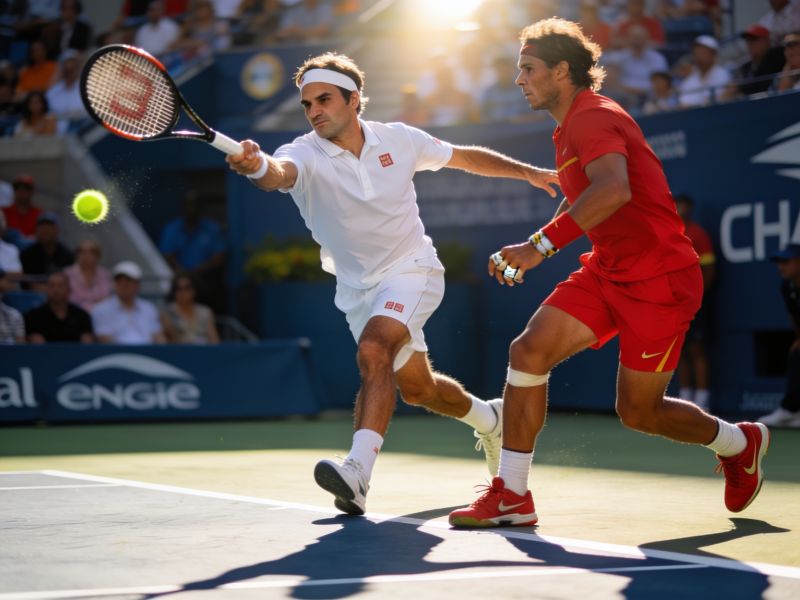
the ball rose sharply and arrived with enough spin to push an opponent several steps behind the baseline. Federer and Nadal made those demands public, and their example influenced a generation that trained for greater athleticism, heavier forehands and more complete movement. Their rivalry also gave the sport a rare emotional balance. Federer often appeared calm and precise, while Nadal played with clenched intensity, but both men showed vulnerability when matches turned against them.Off court, Federer and Nadal gradually became collaborators as much as competitors. They appeared together in exhibitions and charity events, supported initiatives linked to their foundations and spoke warmly about the privileges and costs of elite tennis. Their relationship never erased the competitive edge. Nadal still celebrated fiercely after beating Federer, and Federer continued to search for tactical solutions long after Nadal had exposed weaknesses in his one-handed backhand. When Federer retired at the 2022 Laver Cup。
Nadal joined him for a doubles match in London. The photographs of the two champions sitting side by side, both in tears, were more revealing than any prepared speech. Federer and Nadal had spent years trying to defeat one another, yet the moment also showed how deeply their careers had become connected.Nadal’s retirement from professional tennis at the 2024 Davis Cup marked another quiet closing chapter for Federer and Nadal. Their records will remain central to every debate about the greatest player, but the deeper legacy is visible in how audiences watched tennis during their peak. A final between Federer and Nadal felt important even before the first serve because the match promised conflict。craft and consequence. Their rivalry crossed national boundaries without losing its local texture: Spanish supporters brought drums and flags, Swiss fans answered with red shirts, and neutral spectators often found themselves changing allegiance point by point. Federer and Nadal also offered a model of fierce competition without manufactured hostility. They disagreed through shot selection, court position and nerve rather than public insults. That restraint made the drama sharper. Years after their final meeting, Federer and Nadal remain inseparable in the public imagination, not because they were identical champions, but because each made the other more complete.